
Knife crime has featured prominently in the news at the start of 2025. Three teenage boys were charged with the murders of Kelyan Bokassa (14) and Harvey Willgoose (15) in separate incidents in London and Sheffield. Axel Rudakabana was sentenced to 52 years in prison following his murderous knife attack at a Southport dance class last summer, in which Elsie Dot Stancombe (7), Alice da Silva Aguiar (9) and Bebe King (6) died. And an unnamed 14-year-old girl was recently convicted for the attempted murder of a classmate and two teachers in the Welsh town of Ammanford.
In this article, Dynamis Director of Training Gerard O’Dea sheds some light on the psychology behind young people who carry knives — and reveals three things staff need to know when working in environments where young people may be carrying knives.
1. Understand the SCARF model — particularly the ‘S’ (Status)
Why do some young people carry knives?
The Bridge House Trust’s report “Fear and Fashion” sought the views of practitioners working with young people who carry knives and other weapons. It concluded that fear of crime, experience of victimisation (direct or otherwise) and the desire for status in an unequal society are the chief motivations for carrying a knife.
Fear and victimisation play the most significant role in a young person’s decision to carry a knife or weapon.
Bridge House Trust, Fear and Fashion
The possession of a knife or other weapon can also be a means of acquiring status. Children who experience failure at school or other kinds of social exclusion could be looking for status by carrying and brandishing a knife.
Bridge House Trust, Fear and Fashion
Research tells us that young men of teenage years are the most likely to carry a knife or blade. Writers like David Rock (with his evidence-based SCARF model of behavioural influencers) and Rory Miller (with his insights on the ‘Monkey Dance’ of violence dynamics) have pointed to status as a key driver of human behaviour generally.
The effect of status is magnified in the lives of young teenage males, who are extremely sensitive to their perceived place in the hierarchy of relationships around them. Some are vulnerable to suffering the catastrophic loss of esteem and regard from their peers in an instant — if they ‘lose face’ or ‘back down.’
The most dangerous moment I can predict is when a young person leaves an interaction with a team believing that they have been disrespected and have lost status.
Gerard O’Dea, Dynamis
For this reason, what contact professionals say — and the way they say it — can be a matter of life and death in high-stakes situations where knives may be present.
2. Show respect and demonstrate fairness at all times
When asked to present a course about edged weapon protection for staff whose client group is teenagers on the streets or in our schools, the most important advice is this:
Be mindful that the young people you are working with on the streets are especially sensitive to issues of status, respect and face — both within your relationship with them, and in front of their peers.
The best way to ensure you don’t end up on the tip of a blade is to make sure it is perfectly clear that you are showing them respect.
Gerard O’Dea, Dynamis
When we are treated with disrespect, feelings of revenge, retaliation, retribution, making things right or re-gaining face naturally arise. In his model of violence dynamics, Rory Miller identifies the ‘Status Seeking Display’ — a behaviour aimed at building up or rebuilding a reputation in jeopardy.
⚠️ How a status-seeking display can unfold:
1. Young person feels disrespected / loss of status during an interaction with the team
2. Resentment builds in the minutes, hours, days afterwards
3. Young person thinks about how to get revenge, retaliation or retribution
4. Other factors combine in a perfect storm of bad decisions
5. Young person puts a knife in their jacket and thinks about using it
6. Another bad interaction triggers over-reaction
7. Catastrophic loss of self-control
8. Young person uses the knife in an act of violence against an individual.
It all started with the perception of being shown respect — or not.
The procedural justice question
The vital question Dynamis addresses in all its training around de-escalation, conflict and personal protection becomes: how can we ensure that the young people we interact with are treated with dignity and are shown respect at all times — even when we are having high-stakes interactions with them?
Even when we are writing people up for violations, or presenting them with the consequences of their negative behaviour, we need to do it in such a way that they believe they have been treated fairly — according to procedure, with empathy, and at all times allowed their dignity.
Procedural justice states that how a person feels they were treated during an interaction has more to do with how they view the event than the final outcome of the encounter.
Gary Klugiewicz, Vistelar
Procedural justice — sometimes called procedural fairness — is therefore an issue of perception. It is decided by how an individual feels about the way a staff member interacts with them, and this will have a great impact on whether they believe there was legitimacy to the interaction.
To maximise the likelihood of positive outcomes for teams of contact professionals concerned about their risk from knife crime or knife assaults, it is vital to examine the quality of the interactions and relationships with young people as a preliminary step in assessing training needs. Dynamis can support you with this process — book a call with us.
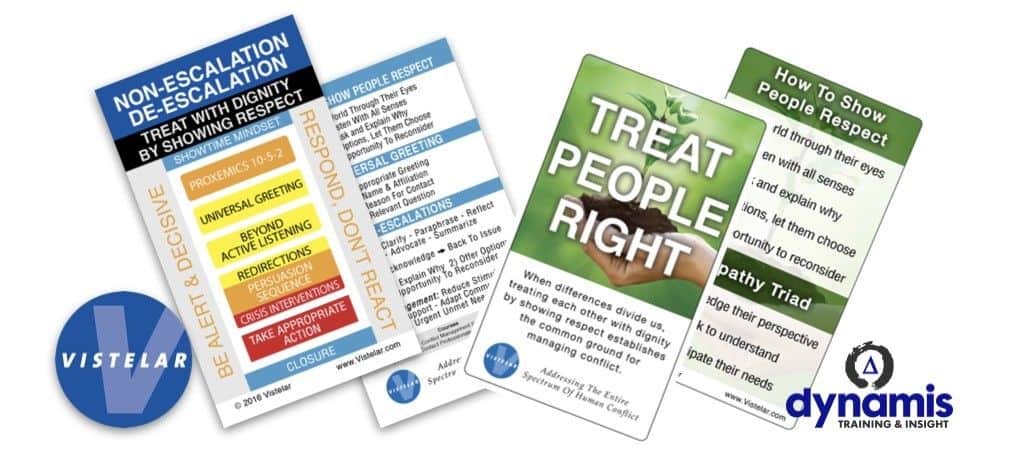
In addition, Dynamis’ Conflict Management training course covers all of the elements of verbal communication mentioned above, in which we work with you to create a supportive atmosphere and one in which conflict is not escalated — or is de-escalated appropriately.
3. When a knife appears
When an edged weapon is suddenly and unexpectedly in play in a conflict situation, successfully navigating such an extreme assault requires the acceptance of paradoxes.
Chief among these paradoxes is an acceptance that although we will try our best to avoid it, it is very likely the blade will touch us and cut us. Liz Hopkin and Fiona Elias, the teachers stabbed in Ammanford last year by a 14-year-old pupil, told the court during the girl’s trial that they thought they were going to die.
These scenarios are as frightening and intense as they come. It is why Dynamis’ specialist edged weapon training course is designed to help staff carefully and safely approach and address the risks of a bladed weapon assault.
We start with simple skills to minimise the effectiveness of slashing, stabbing and thrusting movements. Staff explore the instinctive protective behaviours that are integral to our bodies’ survival systems, as well as the assailant’s predictable behaviours as we interfere with their use of the blade. We progress through stages of training to develop a feeling of control and ‘relative comfort’ with what is happening — gradually helping staff to explore their options for bringing the situation into safety.
This is intense training and requires hours of work. However, we achieve excellent results in safety by carefully replicating the process and pressure of real knife assaults. Dynamis works to achieve the best training fidelity possible through our scenario-based approach, so we can best equip staff to effectively de-escalate conflict situations wherever possible — and, in the worst-case scenario, protect themselves effectively against knife assaults.
⚠️ Important note: We do not want non-police staff walking into or towards a situation where a blade is present. Our job is to help staff deal with the situation when they didn’t know a blade was present — but it is now in use against them or their colleagues, by complete surprise.